
Livermore City Directory Holdings
The verified collection picture is broader than a single printed city directory. Livermore in Alameda County has a documented digitized newspaper run, city legislative records, Heritage Guild objects, census access, Sanborn maps, and local name databases. The library and History Center are the places to confirm an exact printed volume, reverse section, or telephone book year. The table keeps known coverage separate from a shelf run that has not been verified online.
| Collection | Years | Where Held | Access |
|---|---|---|---|
| Livermore Herald | March 28, 1877-May 6, 1899, 156 issues | California Digital Newspaper Collection | Free OCR and page images |
| City Council minutes and ordinances | 1876-current | Livermore City Laserfiche | Free browse and word or phrase search |
| Heritage Guild digital objects | Item-dependent | California Revealed | Free metadata and digital objects |
| Federal population census | 1790-1950, locally relevant from settlement era | NARA, FamilySearch, library databases | Free NARA or FamilySearch; library Ancestry access |
| Printed city and reverse directories | Exact Livermore years not verified in an official online shelf list | Livermore Public Library or Heritage Guild inquiry | Reference or in-person confirmation |
This means a Livermore city directory search may begin online but often ends with a librarian or volunteer checking a non-circulating volume, vertical file, microfilm reel, or local index.
Where Livermore City Directory History Is Kept
Livermore Public Library’s History and Genealogy hub points to HeritageQuest, the California Digital Newspaper Collection, Online Archive of California photographs, Livermore-Amador Genealogical Society resources, Heritage Guild materials, and a local Family History Center. The library database list also shows the current digital-resource route. The Civic Center library provides in-library Ancestry Library Edition and genealogy help programming. Ask the reference desk to search “Livermore directory,” “telephone directory,” “Polk,” “Haines criss-cross,” yearbook titles, and family histories.
The Heritage Guild History Center occupies the 1911 Carnegie Library at 2155 Third Street. Its holdings include original and microfilmed newspapers, a volunteer index, maps, property-tax logs, oral histories, more than 5,000 photographs, old business directories, and local archives. Posted hours are Thursday through Saturday, 11:30 a.m. to 4 p.m., and the first two Sundays, 10 a.m. to 2 p.m., subject to live confirmation.
Open the Heritage Guild History Center information before planning a visit.
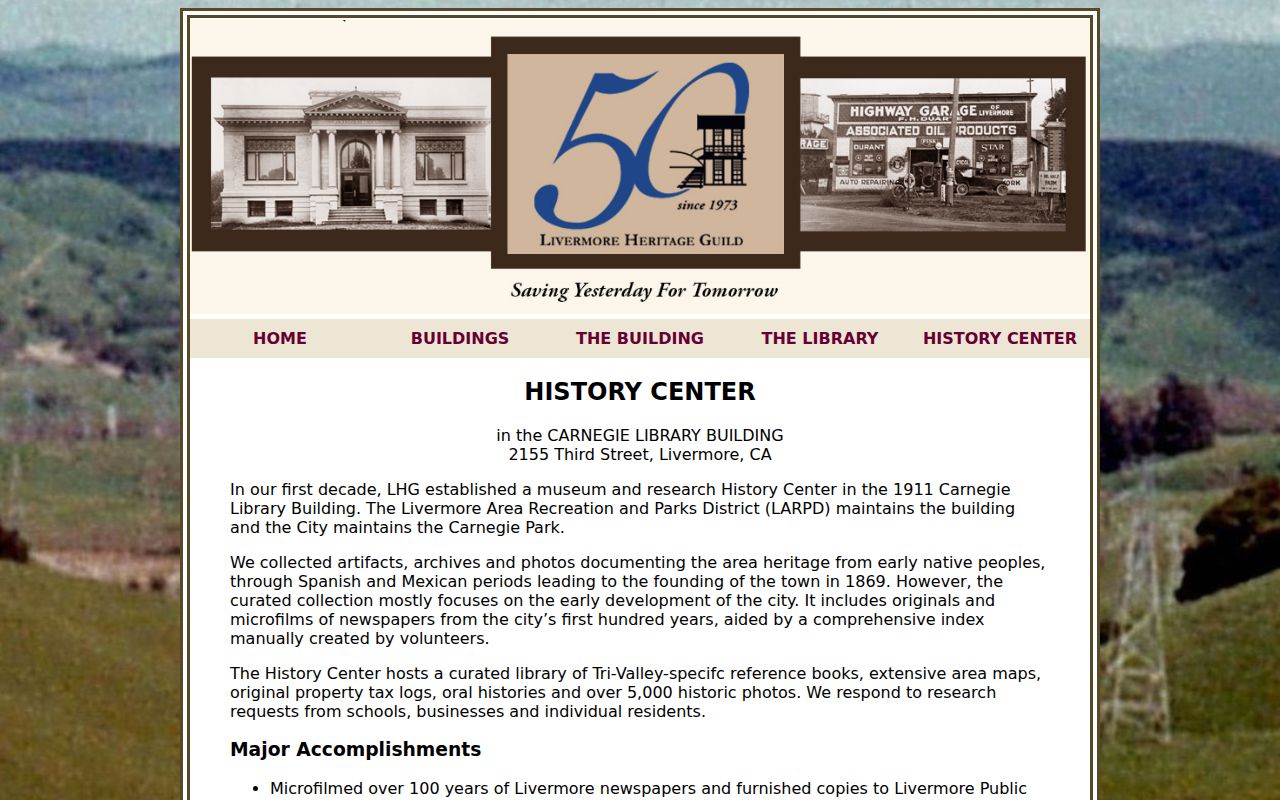
The local shelf is valuable because volunteers can connect a name to a map, business file, newspaper clipping, or property-tax note that a broad web search would miss.
The Livermore City Directory Shelf Check
Research did not verify a continuous list of Livermore printed city directory titles, publishers, or years in an official online catalog. That gap is important. Do not turn a generic Polk or Haines reference into a claim that a specific local volume exists. Ask the library or Heritage Guild to confirm the edition, call number, format, and whether it has a reverse section.
Record the answer carefully. A library-held item may be non-circulating. A microfilm run may require a reader. A volunteer index may cover only selected surnames or newspapers. A directory that disappears for one year may reflect a publication gap, a move, an omitted household, or a cataloging gap. Each outcome calls for a different follow-up.
- Collection year
- The edition date printed on the volume, not the date a catalog record was added.
- Reverse directory
- An address-order section that can move from a street to an occupant entry.
- Local history room
- A reference collection where staff or volunteers may handle non-circulating material.
- Research gap
- A fact not verified in the available source, not permission to infer it.
How Livermore Directory Entries Read
A directory entry is compact. Read every mark before deciding what it says about a household. The local abbreviation key controls the meaning of “h,” “r,” a widow notation, an ownership symbol, or a spouse in parentheses. Because a verified Livermore entry image was not available during research, the inventory below is a field model rather than a quotation from one volume.
| Name | Surname, given name, or initial; a spouse may appear in parentheses. |
|---|---|
| Occupation | Trade or profession and sometimes the employer. |
| Home or room mark | Local notation can distinguish a home from a rooming or boarding entry. |
| Address | House number and street as printed for that edition. |
| Widow marker | A relationship clue that may help separate same-name entries. |
| Ownership symbol | Some volumes mark ownership or rental status; use the edition key. |
Start with the abbreviation key. Then copy the entry exactly, including initials and punctuation. A small spelling change can hide the same family in the next year or in a newspaper index.
- Criss-cross directory
- The reverse, address-order part of a volume, where a street can lead back to a name.
- Householder index
- A name route centered on the head of a household, not necessarily every person present.
- Abbreviation key
- The volume’s own legend for occupation, relationship, home, room, and ownership marks.
Livermore City Directory Clues in the Herald
The California Digital Newspaper Collection documents 156 Livermore Herald issues from March 28, 1877 through May 6, 1899. Search OCR by surname, address, business, ranch, winery, school, or street, then browse the page image and neighboring columns. Narrow columns, unusual type, and damaged pages can defeat OCR. A hit is a clue until the printed page is read.
Newspaper notices can supply a death, visit, sale, civic petition, business connection, or address that helps explain a directory gap. Compare the result with a deed, Council minute, cemetery record, or probate file. The Barbara Bunshah Selective Subject Index adds local name access across Enterprise, Independent, Livermore Herald, Herald and News, and Tri-Valley Herald segments, but it points to articles rather than replacing them.
Open the Livermore Herald collection to test the OCR and page-image route.
The digitized run is especially useful for the years when a printed city directory is hard to locate. It provides a dated local voice that can be paired with an address entry.
Trace a Livermore Household Across City Directories
Directory continuity is a hypothesis, not a fact. Follow one name through editions, record the address and spouse or occupation clues, and then use a reverse section to see who else appears at the same address. A household may vanish because it moved, a person died, the volume omitted a category, publication paused, or the street changed.
- Find the first plausible surname entry and copy its full wording.
- Check the next available edition for address, spouse, occupation, and abbreviation changes.
- Use the address-order section, if present, to identify nearby entries without treating them as family.
- Pair the directory point with a census year, deed, permit, newspaper, or obituary.
- Write down why the next appearance is the same person rather than relying on a shared surname.
The family-history value lies in the sequence. A directory gives an annual or periodic point between federal census years, while a deed gives title history and a newspaper supplies community context.
Livermore City Directory Years and Census
Public federal population schedules currently run through 1950 because the federal release rule makes that the latest public census in 2026. A directory may place a household at an address before or after a decennial enumeration, while the census supplies names, ages, relationships, and an enumeration address for its own date. Enumeration-district maps help when street names or city boundaries moved.
Use the two sources as a check, not as interchangeable lists. A directory can include a business, a rooming entry, or a person away from the household. A census can miss a person through timing or enumeration error. Add the Livermore Herald, cemetery index, obituary, probate petition, and recorder document when identity matters.
| Source | Best question | Limit |
|---|---|---|
| City directory | Where was a name printed in a given edition? | Exact Livermore years and local symbols require shelf confirmation. |
| Federal census | Who was enumerated at an address in a public census year? | Decennial snapshot; latest public schedule is 1950. |
| Deed index | Which parties were tied to title? | Party and legal-description route, not a household list. |
| Obituary or cemetery index | Can death, kin, or burial corroborate an identity? | Local sets are incomplete and collection-specific. |
Livermore Civic Records as a Directory
City Council minutes and ordinances from 1876-current form an unusual companion to the city directory. Petitions, street work, franchises, subdivision actions, appointments, and claims can place a person beside a parcel, business, or civic issue. Resolutions begin in 1944, Redevelopment Agency minutes in 1981, agenda packets on January 10, 2000, and summary agendas on November 24, 2003.
Use the City Clerk repository’s word or phrase search, then read the surrounding item. A name in a petition may be a property owner, representative, neighbor, or requester. It is a dated civic appearance, not automatic residence proof.
The Livermore public-records gateway shows the browse, search, Council Records, and request channels. The Livermore Heritage Guild adds local-history context for people, streets, and businesses.
The civic trail helps explain why an address appears in one year and not another, especially around subdivision, annexation, or street work.
Local Livermore Directory Name Databases
Livermore-Amador Genealogical Society databases add a local name layer. The documented sets include 5,800 Livermore cemetery names, 4,668 Pleasanton and Dublin cemetery transcriptions, 2,252 Roselawn records, 1,183 Memory Gardens records, 2,560 St. Michael records, mortuary datasets, 1,712 early Livermore obituary entries, 17,219 Schellens Papers names, and 5,217 Alameda County Death Book C names from 1889-1894. The Society warns that some burial and mortuary sets are incomplete.
Use a database hit to find a date, place, kin clue, or source trail. Then ask for the underlying newspaper, cemetery, probate, or vital record when the conclusion needs stronger proof. A historical name database is a path into a collection, not a complete city directory.
Open the local genealogy database list to see the current access route.
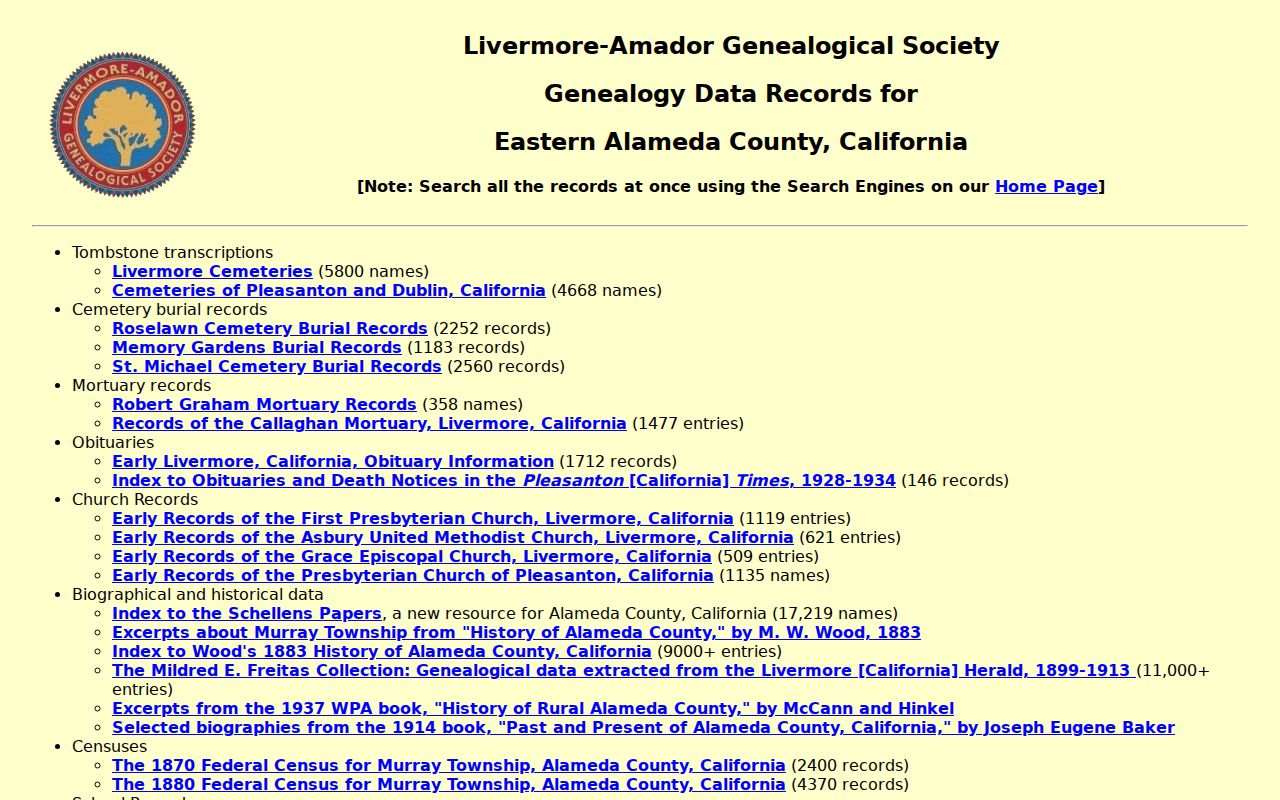
These local indexes are most useful when paired with the exact spelling and date taken from a directory or newspaper.
Bridge Livermore Directory Addresses with Maps
Street names and numbers can change across a long Livermore trail. Sanborn maps documented for March 1884, June 1888, April 1893, November 1907, and May 1917 can show footprints, materials, uses, outbuildings, and old numbering. The Library of Congress collection is a starting point, while the Heritage Guild may provide local context.
When a directory entry does not match a modern address, compare the legal description, parcel lineage, Council minutes, subdivision action, and map sheet. The modern parcel and deed chain belong on the Livermore by-street page. The city directory question remains the historical reading of the old entry and its local abbreviation key.
Note: A directory gap may reflect a changed street, an omitted edition, or a household change; preserve all three possibilities until another source resolves it.